Visit the new CME and conference page! 

Blog:
Vishuddha Voices

Community WISDOM
Connection, presence and Growth
Oct 21 • Siri Chand Khalsa MD

Feet in the Riverbed: Returning to Self With PAUSE

Dr. Priyanka Venkataraman on the nervous system ladder, the PAUSE framework, and remembering who we are beneath all the pushing through.
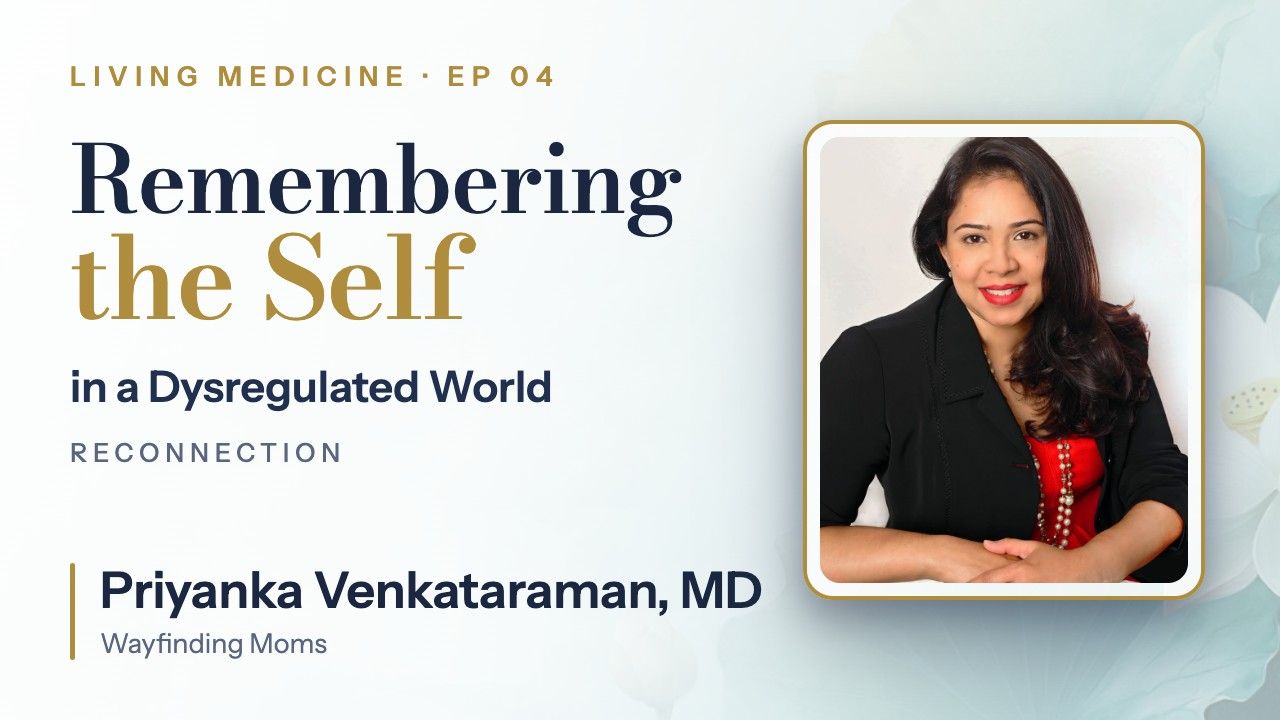
Dr. Priyanka Venkataraman, Reconnection: Returning to Self in a Dysregulated World
Reconnection: Returning to Self in a Dysregulated World
Content note. This post briefly mentions pregnancy loss.

What Does It Mean to Return to Yourself?

Partway through our time together, Dr. Priyanka Venkataraman offered an image I have not been able to set down. A fast river, the water quick and rushing, and a woman standing in it.
If she is not grounded, the current takes her. If she is grounded, feet planted in the riverbed, she gets to choose. She can push forward, flow with it, or step sideways to the bank and rest before going back in.
Dr. Priyanka Venkataraman
Meet the speaker

Dr. Priyanka Venkataraman, MD

OB/GYN · Life & parent coach · Founder, Wayfinding Moms

Priyanka is a board certified OB/GYN, a certified life and parent coach, and the founder of Wayfinding Moms. She helps women reconnect with themselves first, so they can reconnect with their families, their careers and their lives.

wayfindingmoms.com →
Priyanka joined me from the Bay Area. She brought a simple acronym she built for herself during a hard season... PAUSE. She shared it as a tool for the moment and as a reflection practice, one that has grown as she has grown.

What Is Wayfinding?

Priyanka's frame is quiet, and for physicians it is radical. She sees this work as remembering who we were before we stopped looking, more than fixing what is wrong with us.
She learned this partly through Martha Beck's Wayfinder life coach training. The philosophy there, as she described it, is to witness and guide, without rushing in to rescue. Wayfinding, in her telling, is letting go of the clouds that block our view of the North Star.
When we are grounded with ourselves, she said, other connections come more easily, with less strife and less pulling and tugging. The work starts within, and it moves outward.

Practice makes permanent.

It is a phrase she borrowed from a musician, and it carries the whole spirit of her talk. Each time we practice coming back to ourselves, the path back gets a little easier to find.

Get the next recap in your inbox.

One letter after each Living Medicine talk. Unsubscribe anytime.
Thank you. The next recap is on its way.

What Is the Nervous System Ladder?

Priyanka described nervous system states as a ladder. It is a simple map, and it held the whole talk together.
  • At the top, a grounded state. Neither happy nor sad, just content, connected and settled with where we are.
  • One step down, fight or flight.
  • One step below that, freeze.
A fast, dysregulated world will drop us down that ladder, and she was clear that this is okay. Falling is part of it. What we can practice is climbing back up a little more quickly each time.
She also named what happens when we stay low for too long. Burnout does not stay emotional. She described it showing up in the body as inflammation, weight that holds on, clogged arteries and other health problems. Without rest and digest, she said, we are not repairing... even our DNA is not repairing.
One more piece of mechanism, offered plainly for patients and clinicians alike. Curiosity and anxiety draw on different parts of the brain. In her words, when we are curious, we can't be anxious.

The current is not the problem. Losing our footing is.

What Does Physician Burnout Look Like?

Priyanka grew up with a message many of us know. Keep moving forward, push through, stay on the straight and narrow path.
She did. Twelve years of training after high school, then twelve years as a physician, with no breaks and blinders on.
By 2018 she was interviewing for other jobs, hoping somewhere else would feel better. Nothing did. Looking back, she sees it as burnout. She simply never knew how to stop.
That same year she had a miscarriage. In 2019 her son arrived after a frightening pregnancy she calls a miracle. Then came 2020, with full clinical days, a baby with feeding struggles and the long strain of the pandemic. In 2021 she broke her ankle on a Sunday and was back at work on Tuesday. On a 24 hour call shift that weekend, the boot stayed on for 17 hours.
What finally stopped her was her son. Once he started daycare, illness after illness kept him home. She and her husband traded shifts for a month, and then they had the conversation... one of them would let go, or both would be let go. She left clinical medicine in March of 2022, with no next step planned.
She calls him her teacher. I understood why.

What Is the PAUSE Framework?

Priyanka's acronym works in the heat of a moment and on the page afterward. She uses it in conflict, in parenting and in journaling. Tap each letter to read more.
01P is for pause and presence.

Two ways in. First, lower your baseline with practices like yoga, exercise, meditation, walks in nature, stillness or journaling. She does a five to ten minute body scan before getting out of bed, feet to head. Second, come back in the moment. Rub your fingertips together. Place one hand on your chest and one on your belly, and let the breath move the lower hand.

02A is for awareness.

Name the feeling. Notice the body: a racing heart, tight shoulders, a tight jaw. Awareness alone creates a little distance from fight or flight.

03U is for understand.

Get curious. Why am I triggered? What from my past is this reminding me of? What is my unmet need right now? Usually, she said, it comes back to safety.

04S is for self.

Put yourself first. Ask what you need to feel safe in this moment. From there come self acceptance, self care, self compassion and self love.

05E is for effectively respond.

Once you are grounded, respond instead of react. Sometimes that means saying this conversation is not working right now, and coming back to the table later.

With children, she keeps it simple. Breathe in like smelling a flower. Blow out like a candle. Talk about feelings, and ask together... am I tired, am I hungry, am I overwhelmed?

How Do You Make Calm a Habit?

Priyanka borrowed a phrase from a musician. Practice makes permanent, more than it makes perfect.
Each time we reflect on a hard moment, we strengthen the path back. Over time, she said, the whole acronym can move in five seconds flat.
She was honest about how long the old patterns run. On her first day after leaving medicine, she did six loads of laundry. She did not know how to be still. Even now she catches herself folding clothes and putting off a trip to the bathroom, then looking up an hour and a half later, twenty tasks on.
It is such a small thing, and it holds the whole lesson. Listening to the body instead of overriding it.

What Are Parts in Internal Family Systems?

Priyanka widened the lens with internal family systems, the therapy developed by Dr. Richard Schwartz. In this model, each of us holds a family of parts formed by experience... a hurt younger part, a protector standing in front of it, managers keeping things running.
We tend to shove these parts down in the basement, she said, and that is how we lose connection with ourselves. When we let them come up and we listen, we stay as the compassionate witness. Dr. Schwartz calls this the capital S Self.
She offered an exercise for two parts in conflict, drawing on Dr. Jill Bolte Taylor's work. Place the part with the checklist, the one that says keep going, in your right hand. Place the part that wants freedom, openness and creativity in your left. Give each a name or an image, and let them speak to each other while you stay as the witness. That separation alone softens the anger and the tension.
She returned, too, to an image many caregivers know. If we keep pouring out, we run dry. If we fill our own cup first, it can overflow into the cups around us.

Who Am I If I Leave Medicine?

The hardest belief in Priyanka's transition was simple. Without her work as a physician, she would not know who she was.
Through coaching, she turned it around. If she stayed in medicine the way she had been practicing, she would never get to know who she was. That shift opened the door to grieving her old identity, and then to dreaming.
She found a creative self. She found she does not need every answer first. When someone told her the people she was meant to serve were already waiting, she sent out a Zoom link the next week, with no website and no sign up page. That gathering became the Village, a free community that meets once a month, and it has kept growing.
Wayfinding, she reminded us, means we are all still finding our way. That felt like permission to stop trying to arrive, and simply keep returning.

Know a colleague who could use this? Please pass it along.

Siri Chand Khalsa MD
Written by

Siri Chand Khalsa MD

Siri Chand is board certified in internal, integrative, lifestyle, and hospice and palliative medicine, with nearly 30 years of clinical practice. She founded Vishuddha to build the community medicine denied women physicians. The Living Medicine Series is one way we gather.

P.S. If something here stayed with you, the full conversation goes deeper. The whole talk is in the Living Medicine Series →
Medicine trained many of us to give care and rarely to receive it. I created this series so women physicians have a place to learn from each other and feel met.
With love, Siri Chand
From Dr. Venkataraman's talk

Questions to sit with

  1. Where on the ladder do you spend most of your day? What is one small practice that could lower your baseline before the day begins?
  2. Which part of you is holding the checklist right now? What might it need from you in order to rest?

Choose one quiet hour this week. Watch the talk, then answer the first prompt.

Full conversation and companion worksheet in the Living Medicine Series.

Watch Dr. Venkataraman's talk
More from the Living Medicine Series

See every talk →
Write your awesome label here.

Learn with our experts. 

We will help you explore and build your core insight and knowledge about yourself and the work you do in this world.
The Vishuddha app

Read on the go.

Every Living Medicine recap, talk and companion worksheet, in your pocket. Read between patients, on the train, or wherever you find a quiet minute.
Dr. Priyanka Venkataraman
Living Medicine, Episode 4

Catch Up With Recent Blog Posts