Blog:
Vishuddha Voices

Community WISDOM
Connection, presence and Growth
Oct 19 • Siri Chand Khalsa MD

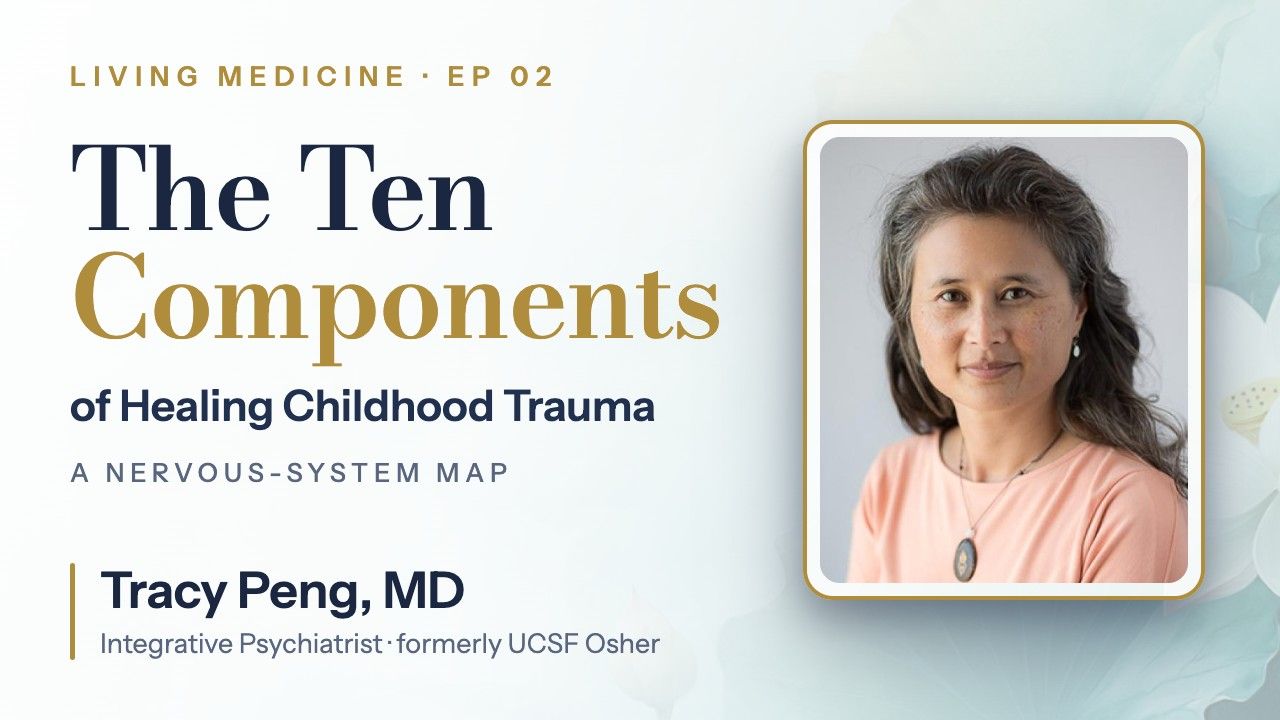
What Heals Us: The Ten Components of Healing Childhood Trauma

Hi! I'm Siri Chand 

Welcome to the Vishuddha blog.

In our Living Medicine Series, physicians share the work that widens what medicine can be. These recaps carry what they taught us.

This time: Dr. Tracy Peng, integrative psychiatrist, on healing from childhood trauma.

Join us to watch the full talk.

A Map, Not a Protocol

A note before you read: this post touches on childhood abuse and trauma. Take your time with it.

The fog was sitting low over Diamond Heights when Dr. Tracy Peng joined us from San Francisco. Soft. Gray. The kind of weather that makes a city go quiet.

It was a fitting backdrop. Her talk was about what happens beneath the surface of a life. And what it takes to clear.

Tracy has spent more than 20 years as an integrative psychiatrist, most of them at the UCSF Osher Center for Integrative Health. She was our first speaker in the Living Medicine Series. What she brought was not a protocol. It was a map.

Starting With Wholeness

Tracy opened with a term most of us were never taught in training. A coherent field.

She borrows the definition from Judith Blackstone. A subtle, all-pervasive field of awareness that holds our inner and outer experience as one. Compassionate. Loving. Healing.

In plain terms, it is the felt sense of being held. The quiet of a garden. A room full of people meditating together. A ceremony. A good hands-on healer. Tracy believes contact with our own wholeness is a birthright. Trauma can bury it. It does not erase it.

She was honest about where she does not find this field. Western medicine, she said, gave her oaths and white coats but rarely a felt sense of healing. And a diagnostic manual that lists symptoms, without that field around it, can leave people feeling like damaged goods.

She also offered a reframe from her teacher Rachel Naomi Remen, who died just days before we recorded. Healing, in Remen's view, may be less about getting better and more about releasing everything that was never truly you.

Trauma can bury our wholeness. It does not erase it.

What the Research Shows

Then came the harder material. Tracy walked us through the landmark CDC and Kaiser Adverse Childhood Experiences study, led by internist Vincent Felitti and published in 1998. More than 17,000 adults. Ten categories of abuse, neglect, and household dysfunction.

The findings follow a dose-response curve. The more adversity in childhood, the higher the risk later.

  • About two thirds of participants had at least one adverse experience. Roughly one in eight had four or more.
  • Four or more meant about double the odds of ischemic heart disease, close to four times the odds of COPD, 2.4 times the odds of stroke, and 4.6 times the odds of prolonged depressed mood.
  • People with six or more died, on average, about 20 years earlier than those with none.

Tracy pointed out something easy to miss. This was a largely white, largely college-educated population. A privileged group. Two thirds of them still carried at least one of these experiences.

The stress response reaches everywhere. Immune function. Hormones. Heart. Gut. Even methylation and telomere length. On imaging, childhood adversity is linked to a smaller hippocampus, a smaller prefrontal cortex, and a larger amygdala.

Then she said the sentence that matters most. These scores are not destiny.

"These scores are not destiny." Dr. Tracy Peng

Dr. Tracy Peng, Healing Childhood Trauma, Living Medicine Series

A Patient Who Taught Her

Tracy shared the story of one patient she has walked with for seven and a half years. A woman who came in believing she had one adverse experience. Over time, together, they understood it was closer to four.

This is common, Tracy said. People arrive saying they had a happy childhood. You listen a little longer. It does not sound so happy. Denial was how they survived.

What helped was not one thing. Medication. Twice-weekly therapy. Tapping before meditation, because relaxation itself had once felt unsafe. Swimming. Walking. A true nap when old fear rose up.

And an image that came from the patient herself. A golden river. Tracy returns to it again and again to point her back toward her own knowing. It never fails.

The Ten Components of Healing

This is the heart of the talk. Tracy's framework names ten things that help people heal from early trauma.

  1. Biological support. The right specialists, nutrition, sleep, and functional care for the body's real conditions.
  2. Mental health support. Often weekly therapy first, so a person can tell an accurate story of what happened. Internal Family Systems and somatic therapies can help.
  3. Mind-body practices. Meditation, yoga, breathwork. Powerful, and sometimes triggering, so best with therapy already in place.
  4. Physical release. Trauma releasing exercises, craniosacral work, trauma-informed yoga. Always with a deeply ethical practitioner.
  5. Energy medicine. Acupuncture, tapping, and other approaches that work with the subtle body.
  6. Willingness to change. An openness to unfamiliar territory. Often it arrives through suffering.
  7. Access to fundamental well-being. A felt sense of being okay, underneath everything.
  8. Safe places. Nature. Creative spaces. Animals. One of her patients named the hair salon. Another, the coffee shop.
  9. Collective trauma healing. Grief groups, support groups, family constellations. Healing that happens together.
  10. Resources. Money matters. Access matters. Healing needs to be democratized.

She was careful about one tension. Naming what happened is essential. Getting stuck in a victim identity is not. The art is in unpacking the harm while remembering the person is whole.

One Safe Adult

One line from the talk stayed with me. Even a single safe adult can change a life.

Tracy offered Oprah Winfrey as an example. A high score. And an elementary school teacher who believed she was smart and loved her. That belief, Tracy said, can be the difference between collapse and moving forward.

Many of us in medicine have been that adult for someone. Many of us needed one.

Small Islands of Coherence

Tracy closed by widening the lens. Families carry trauma. So do nations. So does medicine.

She spoke plainly about corporatization and how it has thinned the healing field in many clinics. About telling the truth without needing to look perfect. About physicians who are asked to practice below their own excellence.

Her last slide held a line from Barbara Marx Hubbard. Small islands of coherence in a sea of chaos can shift the whole system.

That is what we hope Vishuddha can be. One small island. A place where women physicians can speak from the heart and be met.

The Other Side

Tracy's parting words were simple. The more trauma we face and release, the more room there is for joy.

There is a new way of living on the other side.

Watch the Full Talk

The complete conversation, including our discussion after the talk, lives in the Vishuddha Living Medicine Series. Tracy's companion worksheet is there too, with reflection prompts to sit with.

Choose one quiet hour this week. Watch the talk. Then answer the first prompt: where in your life do you already feel held?


Learn more about Dr. Peng's practice at tracypengmd.com.

If this post brings something up for you, please reach out to someone you trust or a mental health professional.

Set Aside time to explore this more 

Questions to sit with:

From Dr. Peng's companion worksheet
Where in my life do I already feel held? Which of the ten components am I engaging, and which are missing?
Who is one safe adult I can name, past or present? What is one small island of coherence I can nourish this week?
Write your awesome label here.

Learn with our experts. 

We will help you explore and build your core insight acknowledge about yourself and the work you do in this world.

Catch Up With Recent Blog Posts