Blog:
Vishuddha Voices

Community WISDOM
Connection, presence and Growth
Oct 20 • Siri Chand Khalsa MD

The Cage We Were Taught Not to Leave

Hi! I'm Siri Chand 

Welcome to the Vishuddha blog.

In our Living Medicine Series, physicians share the work that widens what medicine can be. These recaps carry what they taught us.

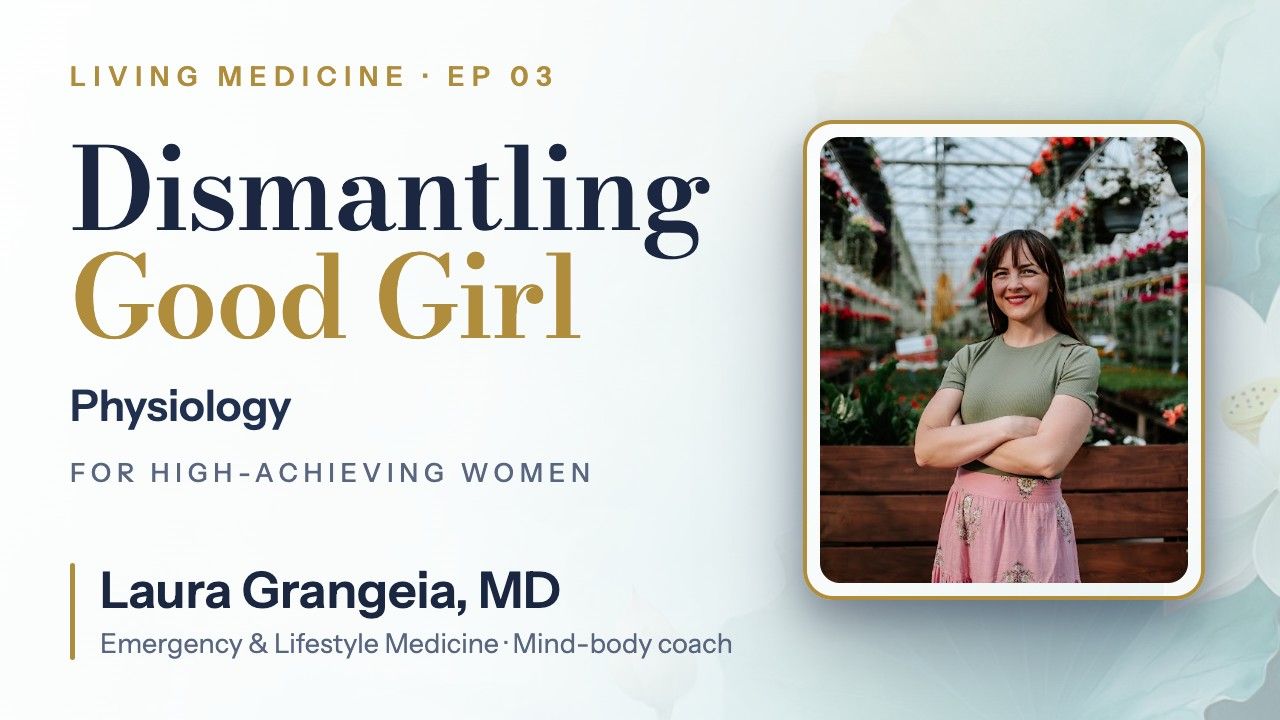
This time: Dr. Laura Grangeia, emergency and lifestyle medicine physician, on the physiology of good girl conditioning.

Join us to watch the full talk.

A Heartbeat, a Second Voice

This talk briefly touches on personal safety and on chronic illness.

Someone asks for help. Nothing about it is threatening. Still, the heart beats a little harder. A quiet voice says, don't. Then a second voice arrives right behind it. Don't be rude.

Dr. Laura Grangeia began near there, with a moment most of us know in the body before we can name it. She joined us from central Pennsylvania. She is board certified in emergency medicine and lifestyle medicine, with a deep interest in mind-body medicine. She also calls herself a recovering good girl.

What she brought was a map. How a set of beliefs, learned early and rewarded often, becomes a physiology. And how that physiology can begin to change.

Rules We Never Agreed To

Laura defined good girl conditioning as a learned pattern. Suppressing your own needs, emotions and boundaries to put compliance, peacekeeping and outside approval first. It is often seen in women and girls. She was clear that it is not limited to them.

In daily life it looks like people pleasing. Conflict avoidance. Emotional suppression. Perfectionism.

She grouped the underlying beliefs into three clusters. Service and belonging: who I am is how I serve, and everyone's comfort is my job. Silencing the inner world: my needs are a burden, my voice is a threat, I should be grateful. Safety through smallness: don't take up too much space, be easy to be around, be perfect so no one can criticize you.

Psychologist Dana Jack named the core of it in 1991. Self-silencing. It has been associated with depression, IBS, chronic fatigue, anxiety and premenstrual dysphoric disorder. Each cluster is a form of it. Each asks the body to stay on alert.

Inflammation is not the enemy. The broken off switch is.

Five Off Switches

Laura's frame was simple, and I keep returning to it. Healthy inflammation is local and self-limiting. It does its job, then it stops. A normal stress response spikes and returns to baseline. When the threat always feels one interaction away, that return never comes.

Cortisol is meant to be the brake. Under chronic stress, cells stop listening. A receptor problem, she stressed, not a hormone problem. She traced the failing off switch through five systems: the HPA axis, the sympathetic nervous system, the bone marrow, the vagus nerve and the epigenome.

  • Surgical residents on active ICU and call shifts showed higher circulating monocytes and neutrophils than on days free of clinical duties. Monocyte count independently predicts cardiovascular disease.
  • Lower heart rate variability prospectively predicts a first cardiovascular event in people without known heart disease.
  • Alexithymia, difficulty identifying one's own feelings, has been reported in 10 to 53 percent of people with MS, compared with about 10 percent of the general population.
  • In a cohort of 373 adults, each standard deviation increase in habitual emotional suppression was associated with a 10 percent higher 10-year Framingham cardiovascular risk. Reappraisal was associated with a 5.9 percent lower risk.
  • In a separate cohort of 379 adults, suppression predicted higher C-reactive protein after adjustment.

She was careful. Correlation is not causation. But the pattern is consistent, with a plausible mechanism.

One detail stayed with me. In the stress models she described, the defining feature was not intensity. It was inescapability. Her own interpretation, named as such: the body cannot tell a cage you cannot leave from one you were taught not to leave.

"None of that is a personal failing." Dr. Laura Grangeia

Laura Grangeia, MD, Dismantling Good Girl Physiology, Living Medicine Series

The Most Non-Good-Girl Thing

Laura told her own story plainly. Straight A student. The kind of kid teachers liked. College, medical school, residency, attending. Third year of medical school, feeling like a burden, was in her words a good girl's nightmare.

As an emergency physician, she felt stuck. The life looked successful. It did not feel successful. She would dread a shift for days and relive it for days after. Then she left. It was not the life she wanted, and she had to reach the point where that reason was enough.

When I asked her afterward about the turn, she described a question that kept returning. Is this it? Emergency medicine also kept mortality in front of her every shift. You only have so much time. Do you want to spend it miserable?

A Job Description for a Good Physician

Laura then turned to pain that persists without tissue damage, which the International Association for the Study of Pain named nociplastic pain in 2017. Dr. Howard Schubiner has described a personality profile that predisposes people to it. Perfectionism. People pleasing. Self-criticism. Difficulty saying no. Taking on too much. Guilt at rest.

Years in that state lower the nervous system's threshold for danger. Harmless signals set off the alarm. The symptoms are real. They come from threat detection, not tissue damage.

Then she asked us to notice something. That list, she said, "read like a job description for a good physician."

Perfectionism stacks clinical necessity, legal exposure and what Joan Williams's research calls the prove it again pattern of gender bias. Patient satisfaction scores turn being liked into a metric. And rest carries guilt. She cited research finding that 80 percent of physicians had worked through an illness they would have written a sick note for in a patient.

Each trait, she said, is the cost of something the system failed to do, relabeled as a personality problem. Good girl conditioning leads many of us into medicine. Medicine then rewards it and compounds it.

Restoring Flexibility

The hopeful part. Nearly every loop she described has been shown to be modifiable. Laura offered four directions.

  1. Restore the vagal brake. In one study, 30 minutes of slow, deep breathing raised HRV measures by 21 to 46 percent in healthy participants, compared with 16 percent for an ear clip vagus nerve stimulator. Her caveat: it measured HRV, not disease outcomes.
  2. Teach the stress system to stand down. In a randomized trial of 138 stressed adults, six weeks of MBSR or CBT produced greater cortisol habituation than a wait list. The response became more flexible, not quieter.
  3. Say the things. A meta-analysis of 31 trials with 4,012 participants found a small, delayed but real benefit from expressive writing. Emotional awareness and expression therapy goes further. In 230 people with fibromyalgia, it outperformed education and outperformed CBT on pain.
  4. Rebuild interoception. Years of overriding body signals can erode the ability to sense them. It is trainable. In one smartphone-based pain study, about 72 percent of completers improved meaningfully.

What these share is flexibility. The capacity to activate, then return to baseline. Stuck, she said, was exactly how she had felt.

The Part That Was Never Touched

Laura was honest about the next step. This was not data. It was a belief she holds.

Many traditions describe a part of us beyond conditioning or trauma. Internal Family Systems calls it the Self. Others describe the same structure: an untouched core, a layer that covers it, a practice for reaching underneath. Meditation, prayer, self-inquiry or an IFS-trained therapist can each be a way in.

IFS names eight qualities of that Self. Calm, curious, clear, compassionate, confident, courageous, creative and connected. I had stumbled toward some of those words on my own.

Then she widened the lens to children. What we say to them becomes their inner voice. We can catch ourselves before praising a child for pushing through exhaustion. We can be the generation that noticed the pattern. Each child grows up with less to unlearn.

The Opposite of Trying Harder

Laura closed with what she most wanted us to keep. The exhaustion. The inability to rest. The sense of being trapped inside a life that looks fine from outside. It has a name. It has a mechanism. And the way out is not more discipline.

It is the opposite. Turning down the volume on the conditioning long enough to hear the part of you that simply wants you to be you. Not a five minute fix. One meditation will not undo years. But the pattern is not permanent, and now we know where to start listening.

She thanked us for taking an hour for ourselves. A very anti-good girl thing to do, she said. I agree. It is something to be proud of.

Watch the Full Talk

The complete conversation lives in the Vishuddha Living Medicine Series, along with every other talk in the season.

Choose one quiet hour this week. Watch the talk. Then sit with the questions below.


Learn more about Dr. Grangeia's work at wholewellbeinglm.com.
Set Aside time to explore this more 

Questions to sit with:

From Dr. Grangeia's talk
Which of the three clusters do you recognize in yourself? Where did you first learn it?
When did you last rest without guilt? What would it take to let your body return to baseline today?
Write your awesome label here.

Learn with our experts. 

We will help you explore and build your core insight acknowledge about yourself and the work you do in this world.

Catch Up With Recent Blog Posts